







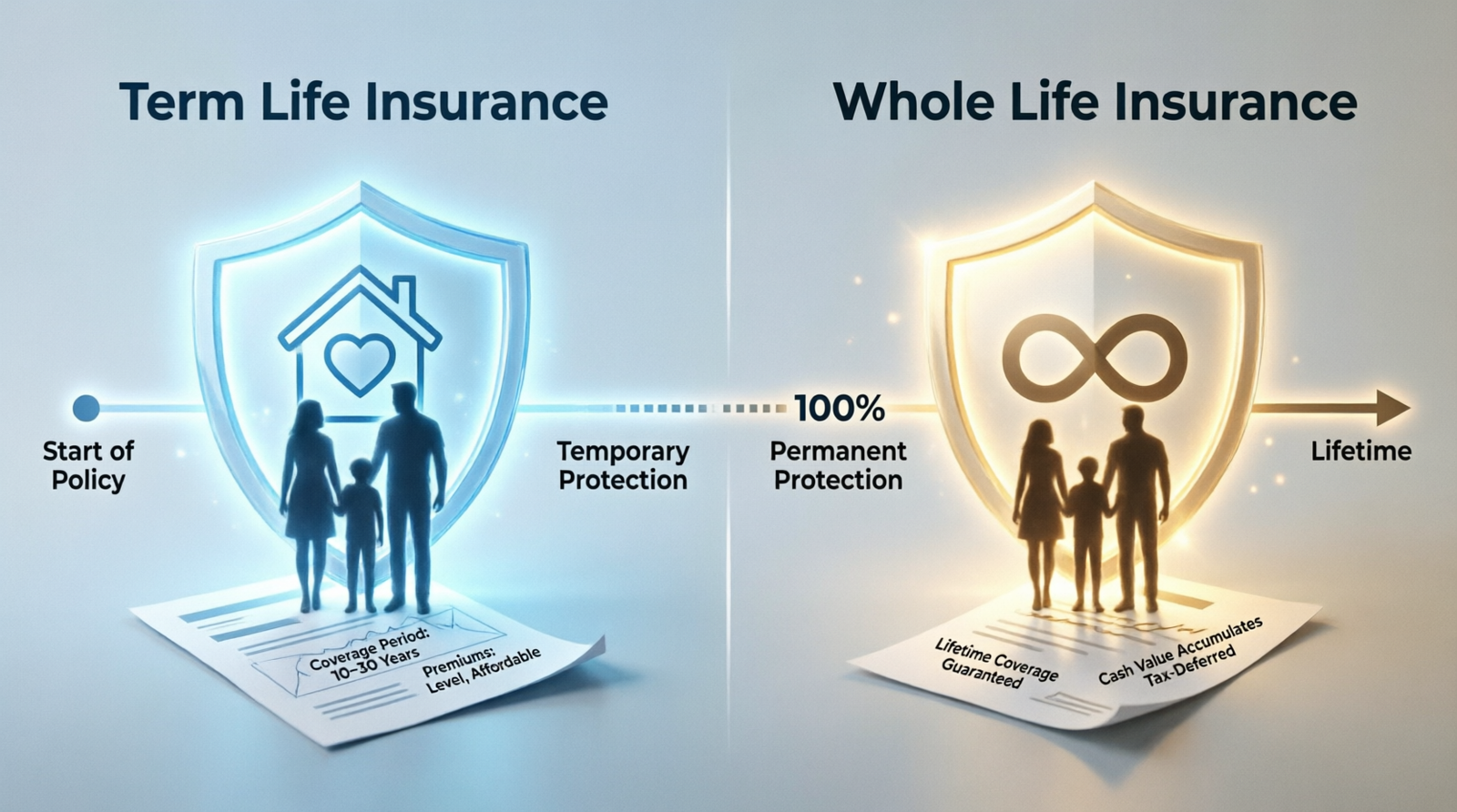
Choosing between term life insurance and whole life insurance can be confusing, especially for first-time buyers. Both types of policies are designed to provide financial protection, but they work very differently in terms of cost, duration, cash value, flexibility, and long-term purpose.
For many people, the right choice depends on their financial responsibilities, income, family situation, long-term goals, and budget.
This guide explains the key differences between term life insurance and whole life insurance so you can better understand how each option works before comparing policies.
What Is Life Insurance?
Life insurance is a contract between a policyholder and an insurance company.
In exchange for premium payments, the insurer agrees to pay a death benefit to the policy’s beneficiaries if the insured person dies while the policy is in force and the claim meets the terms of the contract.
Life insurance can help provide financial support for needs such as:
- Mortgage payments
- Household expenses
- Childcare
- Education costs
- Outstanding debts
- Funeral expenses
- Income replacement
The amount and type of coverage needed varies from person to person.
What Is Term Life Insurance?
Term life insurance provides coverage for a specific period of time.
Common policy terms may include:
- 10 years
- 20 years
- 30 years
If the insured person dies during the policy term and the policy is active, the beneficiaries may receive the death benefit according to the policy terms.
If the insured person outlives the term, the coverage may end unless the policy is renewed, converted, or replaced.
Term life insurance is often considered simpler than permanent life insurance.
What Is Whole Life Insurance?
Whole life insurance is a type of permanent life insurance.
Unlike term insurance, whole life coverage is generally designed to remain in force for the insured person’s lifetime, provided required premiums are paid and policy conditions are met.
Whole life policies may also build cash value over time.
This cash value component is one of the main differences between whole life insurance and term life insurance.
Term Life Insurance vs Whole Life Insurance
The main differences involve duration, price, cash value, and long-term structure.
Coverage Duration
Term life insurance provides coverage for a fixed period.
Whole life insurance is generally designed to provide lifetime coverage.
For example, a person may purchase a 20-year term policy to protect their family during the years when mortgage and childcare expenses are highest.
Another person may prefer permanent coverage because they want lifelong protection.
Premium Costs
Term life insurance is generally less expensive than whole life insurance for the same initial death benefit.
That is because term insurance provides temporary protection and typically does not include a cash value component.
Whole life insurance usually costs more because it combines permanent coverage with cash value accumulation.
Premiums vary depending on many factors, including:
- Age
- Health
- Coverage amount
- Policy type
- Underwriting
- Insurer
- Smoking status
- Other risk factors
Applicants should compare multiple quotes before choosing coverage.
Cash Value
Term life insurance generally does not build cash value.
Whole life insurance may build cash value over time.
The policyholder may be able to access this cash value through certain withdrawals or policy loans, depending on the terms of the contract.
However, borrowing against a policy can affect its value and may reduce the amount available to beneficiaries if the loan is not repaid.
Policyholders should review the financial consequences carefully before using cash value.
Which Is Better for Families?
There is no single answer.
Many families consider term life insurance because it can provide a relatively large amount of coverage at a lower initial cost.
This can be useful during years when financial obligations are high.
Examples may include:
- Raising children
- Paying a mortgage
- Supporting a spouse
- Paying education expenses
- Repaying debt
Whole life insurance may appeal to people who want permanent coverage and are comfortable with the higher premiums.
Who May Consider Term Life Insurance?
Term life insurance may be suitable for people who need coverage for a specific period.
Examples can include:
- Parents with young children
- Homeowners with a mortgage
- Families relying on one primary income
- People with temporary financial obligations
- Buyers seeking higher coverage at a lower initial premium
A term policy can be especially useful when a person’s main goal is income replacement during their working years.
Who May Consider Whole Life Insurance?
Whole life insurance may be considered by people who want permanent coverage.
It may also appeal to individuals who value the policy’s cash value feature.
Potential reasons for considering permanent coverage can include:
- Lifelong insurance needs
- Estate planning considerations
- Final expenses
- Certain business planning needs
- Long-term financial strategies
Because whole life policies can be more complex and expensive, buyers should understand the long-term commitment before purchasing.
How Much Life Insurance Do You Need?
There is no universal amount of life insurance that works for everyone.
A useful starting point is to consider the financial responsibilities that would remain if your income were no longer available.
These may include:
- Mortgage balance
- Rent
- Household expenses
- Childcare
- Education costs
- Debt
- Funeral costs
- Future financial support for dependents
You should also consider existing savings, investments, employer-provided life insurance, and other financial resources.
Factors That Affect Life Insurance Rates
Life insurance premiums are based on underwriting and risk factors.
Age
Age is one of the most important factors.
In general, younger applicants may qualify for lower rates than older applicants, assuming other factors are similar.
Health
Insurers may review medical history and current health when determining eligibility and pricing.
Smoking Status
Tobacco use can significantly affect life insurance premiums.
Coverage Amount
A larger death benefit generally results in a higher premium.
Policy Type
Whole life insurance typically costs more than term life insurance for comparable coverage amounts.
Policy Term
For term insurance, the length of the coverage period can influence pricing.
Does Life Insurance Require a Medical Exam?
Some policies require a medical exam, while others may use simplified underwriting or other methods.
Requirements vary by insurer, policy type, coverage amount, age, and health history.
Applicants should not assume that no-exam insurance is automatically cheaper or better.
Simplified policies may have different pricing or coverage limitations.
How to Compare Life Insurance Quotes
Comparing quotes can help you evaluate both price and policy features.
Compare Similar Coverage Amounts
Make sure each quote provides approximately the same death benefit.
Compare Similar Policy Types
A term policy should be compared with another term policy of similar length.
Comparing a 20-year term policy with whole life insurance solely on monthly cost would not provide a meaningful comparison.
Review Premium Structure
Ask whether premiums are level, guaranteed, adjustable, or subject to policy conditions.
Review Conversion Options
Some term policies allow policyholders to convert their coverage to a permanent life insurance policy.
The terms and deadlines for conversion vary.
Review Financial Strength
Life insurance can be a long-term commitment.
Consider researching the insurer’s financial strength and reputation before purchasing a policy.
Advantages of Term Life Insurance
Term life insurance has several potential advantages.
Lower Initial Cost
Term insurance is generally more affordable than permanent life insurance for the same death benefit.
Simple Structure
Term policies are often easier to understand because they primarily focus on death benefit protection for a set period.
Higher Coverage for Budget-Conscious Buyers
Because premiums are usually lower, some buyers may be able to purchase a larger death benefit within the same budget.
Disadvantages of Term Life Insurance
Term insurance also has limitations.
Coverage Can Expire
If you outlive the term, the policy may end.
Renewal May Cost More
Renewing coverage later in life can be more expensive.
No Cash Value
Most term policies do not accumulate cash value.
Advantages of Whole Life Insurance
Whole life insurance can also provide certain benefits.
Lifetime Coverage
The policy is generally designed to remain in force for life if premiums and policy conditions are maintained.
Cash Value
Whole life policies may build cash value over time.
Predictable Structure
Some policies offer level premiums and guaranteed policy features, subject to the contract.
Disadvantages of Whole Life Insurance
Whole life insurance also comes with trade-offs.
Higher Premiums
Whole life coverage is usually significantly more expensive than term life insurance.
Greater Complexity
Cash value, policy loans, dividends, guarantees, and surrender values can make the policy more complicated.
Long-Term Commitment
Stopping a policy early may have financial consequences.
Is Term Life Insurance Worth It?
Term life insurance can be worthwhile for people who need temporary financial protection.
For example, a parent may want coverage until their children become financially independent.
A homeowner may want protection for the remaining years of a mortgage.
The value of the policy depends on whether it matches your financial needs.
Is Whole Life Insurance Worth It?
Whole life insurance may be appropriate for some people, but it is not automatically the best choice for everyone.
It may make sense for people who want permanent insurance and understand the higher cost.
Because the decision can affect long-term finances, buyers should carefully review the policy and consider professional advice when needed.
Can You Convert Term Life Insurance to Whole Life Insurance?
Some term policies include a conversion option.
This may allow the policyholder to convert some or all of the term coverage into permanent life insurance without going through the full underwriting process again.
Conversion rules vary significantly.
Important factors may include:
- Conversion deadline
- Eligible permanent policies
- Age limits
- Premium calculations
Review these details before buying a term policy if conversion flexibility is important to you.
Should You Buy Life Insurance Through an Employer?
Employer-provided life insurance can be a useful benefit.
However, workplace coverage may not be sufficient for all financial needs.
It may also be tied to your employment.
Some people choose to maintain an individual life insurance policy in addition to employer coverage.
This can provide more control over the amount and duration of protection.
Common Life Insurance Mistakes
Buying Too Little Coverage
A small death benefit may not be enough to support dependents for a meaningful period.
Choosing Based Only on Price
A low premium is useful only if the policy provides appropriate protection.
Waiting Too Long
Life insurance can become more expensive with age, and health changes can affect eligibility.
Ignoring Policy Details
Do not purchase a policy without understanding exclusions, premium structure, duration, and other terms.
Failing to Update Beneficiaries
Life circumstances can change.
Marriage, divorce, children, or other major events may require beneficiary updates.
Frequently Asked Questions
Is term life insurance cheaper than whole life insurance?
Term life insurance is generally less expensive than whole life insurance for a similar initial death benefit because it provides coverage for a limited period and typically does not build cash value.
Does whole life insurance build cash value?
Yes, whole life insurance policies can build cash value over time, subject to the policy terms.
What happens when term life insurance expires?
Coverage generally ends unless you renew, convert, or obtain a new policy. Renewal options and costs depend on the policy.
Can I have both term and whole life insurance?
Some people choose to have multiple life insurance policies or combine different types of coverage, depending on their needs.
How long should a term life insurance policy last?
The appropriate term depends on your financial responsibilities.
Some people select coverage that lasts until major obligations, such as a mortgage or children’s education expenses, are expected to decrease.
Does life insurance pay out immediately?
Claims generally require review and processing by the insurer. Payment timing depends on documentation, policy terms, and the circumstances of the claim.
Which life insurance is best?
There is no universal best policy. The appropriate option depends on your budget, coverage needs, financial responsibilities, health, and long-term goals.
Final Thoughts
The choice between term life insurance and whole life insurance depends on what you want the policy to accomplish.
Term life insurance can provide substantial protection for a fixed period at a relatively lower initial cost, making it attractive for families with temporary financial obligations.
Whole life insurance provides permanent coverage and may accumulate cash value, but it generally requires significantly higher premiums.
Before making a decision, compare multiple policies, review the terms carefully, and consider how the premium fits into your long-term budget.
A life insurance policy should support your financial protection strategy rather than become a financial burden.